
Table of contents
Choosing the right front door hardware is one of the most important decisions when you fit or refurbish an external timber door. Whether your door has come from a supplier such as LPD or been made to order by a local joinery shop, the front door hardware you fit has to look the part, feel solid in the hand and stand up to years of British weather. At Trade Door Handles we supply a huge range of architectural ironmongery and general hardware for the home, workplace, schools, colleges and commercial buildings, with styles and finishes to suit period, traditional and contemporary timber doors.
This guide is our main pillar on front door hardware for external timber doors. It walks through every part you might need, from handles and letter plates to locks, hinges and door numbers, and links through to the right collection for each one.
Front Door Hardware from a Trusted UK Supplier
Supplied by Trade Door Handles, trusted UK supplier of architectural ironmongery since 1976, with quick nationwide delivery. As part of T.H. Wiggans Ironmongery Ltd, we bring a 50-year legacy to every order, and we have grown into one of the largest suppliers of architectural ironmongery on the internet in the UK, with over 30,000 products. We hold ranges from Carlisle Brass, Zoo Hardware, Heritage Brass (M. Marcus), Atlantic and From The Anvil, alongside UK makers such as Kirkpatrick, Croft Hardware and Samuel Heath that still produce bespoke, handmade exterior door hardware.
We also run two large showrooms in the North West of England, in Kendal and Carlisle, where homeowners and trade customers can see and handle the door furniture on display. Our Carlisle showroom sits only a short drive from two of the biggest ironmongery suppliers in the country, Carlisle Brass and Zoo Hardware, which lets us collect stock the same day and dispatch quickly to trades and homeowners across the UK.
What Counts as Front Door Hardware?
Front door hardware, sometimes called exterior door hardware or external door furniture, is everything fitted to the outside and edge of an external door. On a timber front door that usually means a mix of the functional parts that make the door lock, close and open, and the decorative parts that finish it off. A typical external timber door will use several of the following:
- A handle, knob or pull handle to operate or hold the door
- A lock and/or nightlatch to secure it
- Hinges rated for the weight of an external door
- A letter plate, and often a knocker, bell push or door numbers
- Smaller extras such as an escutcheon, door viewer or threshold
The rest of this guide covers each of these in turn.
Handles, Knobs and Pull Handles for Front Doors


The handle is the first piece of front door hardware most people notice, and on a timber door it does real work as well as setting the style. External timber doors usually use one of two arrangements: a lever or knob that operates a latch or lock, or a fixed pull handle paired with a nightlatch that holds the door shut. Because a front door is heavy and used every day, it pays to choose well-made handles with a solid feel and a finish suited to outdoor life.

Door handles on backplates and roses
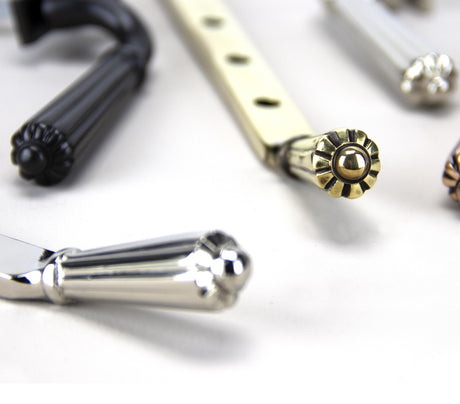
Lever handles come mounted on a long backplate or on individual round or square roses. Backplate handles suit period and traditional front doors and often combine the latch and the keyhole in one plate - and you can specify the backplate to match your lock, whether that is a standard mortice keyhole, a euro profile or an oval profile cylinder. Rose handles fix on separate round or square roses and give a cleaner, more contemporary look, with concealed-fix roses hiding the screws for a neat finish.
Two things matter more on a front door than on an internal one. First, choose a well- sprung handle: heavy external locks put more load on the lever, and an unsprung or lightly sprung handle can start to droop over time. Second, check the handing, as some lever designs are handed (left or right), so confirm which way your door opens before you order.
Pull handles and knobs
Many front doors use a fixed pull handle or a centre door knob on the outside, with the door secured by a nightlatch and simply pulled to. Pull handles come in straight, bow and D shapes and in a wide choice of finishes and lengths, measured by their fixing centres. On an external door it is worth fitting a pull with bolt-through fixing rather than woodscrews alone, as this is far stronger and more secure for everyday use. On glazed or commercial entrance doors you will often see back-to-back pull handles, with a matching pull on each face.
Knobs work a little differently. A rim knob pairs with a nightlatch on the door face, while a mortice knob operates a latch or lock through the door - though mortice knobs need a heavy, well-sprung lock to feel right, so they tend to suit lighter latches better. Whichever route you take, you can browse the full range of levers, knobs and pulls in our door handles and knobs collection.
Choosing the right front door handle
A quick checklist before you buy:
- Operating or fixed? A lever or mortice knob operates the latch, while a fixed pull or centre knob works alongside a nightlatch.
- Sprung and handed? Choose a well-sprung handle and confirm the handing to suit your door.
- Backplate or rose? Match the backplate cut-out to your lock (mortice, euro or oval), or pick roses for a cleaner look.
- Fixing: bolt-through fixing gives the strongest, most secure fit on an external door.
- Finish: pick an outdoor-suitable finish and match it to your letter plate, knocker and door numbers.
Finger Plates, Kick Plates and Letter Plates
Plates protect the surface of a timber door and add character to the front door hardware scheme. They are some of the hardest-working parts of any door, and getting the size and finish right makes all the difference on a busy entrance.
Finger plates and kick plates
A finger plate guards the area around the handle from marks, scuffs and fingerprints, and on a push-operated door it takes the daily contact instead of the timber. Finger plates come in plain and decorative patterns - Georgian, Art Deco and embossed designs are popular on period front doors - and in common heights such as 300mm and 425mm to suit the door. Most are screw-fixed with matching screws, though some slimmer plates are self-adhesive.
A kick plate protects the bottom of the door from knocks, boots, trolleys and cleaning equipment, which is why they are so common on front doors in schools, surgeries, care homes and commercial buildings. Kick plates are cut to the width of the door and usually come in stainless steel, polished or satin brass, or aluminium, in heights from around 150mm upwards. On a heavy-use door, choose a screw-fixed plate over self-adhesive for a fixing that lasts. See both in our finger plates and kick plates collection.
Letterbox and letter plates
The letter plate (the trade term for the exterior letterbox) is one of the most-used pieces of external door furniture, so it is worth choosing carefully. The two measurements that matter most are the aperture (the size of the opening) and the fixing centres (the distance between the two bolt holes). If you are replacing a letter plate, match both to the existing cut-out in the door, or you will be filling and re-drilling. For UK homes, look for an aperture that meets the postal standard (BS EN 13724) - broadly a slot around 250mm by 38mm or larger - so letters and small packets pass through easily.
There is more to a letter plate than the outer flap. On a front door it is worth considering:
- An inner flap or interior letter plate to tidy the inside face and cut draughts.
- A letterbox brush or draught excluder to seal against wind and rain, which matters on an exposed door.
- An internal cowl, or a plate tested to TS008, which resists anyone reaching or "fishing" tools and keys through the slot.
- A sleeved or telescopic letter plate where the door is thicker than standard.
Choose a brass, chrome, black or satin stainless letter plate to match the rest of the door in our letter plates and covers collection.
Security Hardware for Front Doors
Insurance-rated locks and nightlatches
Security is where front door hardware earns its keep, and the lock is the part your insurer cares about most. Many home insurers ask for an insurance-rated lock on a final-exit timber door, and the right standard depends on the type of lock the door uses:
- Mortice locks: look for a BS3621 5 lever mortice lock, marked with the BSI Kitemark. A deadlock throws a bolt only, while a sashlock combines a latch and a deadbolt so it works with a handle. A 5 lever lock is the norm, as 3 lever locks are generally not accepted for insurance on an external door.
- Cylinder locks: where the door uses a euro cylinder, security is rated by the TS007 star system. Fit a 3 star cylinder, or pair a 1 star cylinder with a 2 star security handle to reach the same 3 star level, to resist lock snapping. Sold Secure Diamond and Secured by Design are further marks worth looking for.
- Nightlatches: a standard rim nightlatch used for daytime convenience is not usually insurance-rated on its own. If you rely on a nightlatch, choose a deadlocking BS3621 version with the Kitemark, and fit it alongside a mortice deadlock rather than instead of one.
A common and reliable setup on a timber front door is a BS3621 5 lever mortice deadlock or sashlock for security, with a nightlatch above it for everyday use. On flats, HMOs and commercial final-exit doors you may need a lock that opens from the inside without a key (a thumbturn or internal knob) so people can escape freely, which is a point to check against fire and building requirements. Always check your own policy wording, as insurers vary, then choose from our locks and latches collection.

Door chains
A door chain lets you open the door a few inches to see who is there before you unhook it fully - a simple, low-cost addition that many people value on a front door. Browse our door chains.
Cylinder pulls
A cylinder pull fits over or beside the rim cylinder on a nightlatch door and gives you something solid to grip when pulling the door shut, so you are not tugging on the edge. See the range of cylinder pulls, including rim cylinder pulls, in our cylinder pulls collection.
Escutcheons and keyhole covers
An escutcheon, or keyhole cover, frames the keyhole and hides the drilled hole and lock mechanism behind a neat plate, giving the door a finished look and protecting the timber around the key. The key thing is to match the escutcheon to your lock so the cut-out lines up with the keyhole:
- Mortice key (standard) escutcheons suit a traditional mortice lock with a bit key.
- Euro profile escutcheons match a euro cylinder lock.
- Oval profile escutcheons match an oval cylinder.
- Blank escutcheons have no keyhole and are used to cover a redundant hole or to balance the door.
Covered escutcheons add a swing cover that drops over the keyhole to keep out draughts, dust and rain, which is handy on an exposed front door. Escutcheons are usually around 50mm to match a standard rose, in round or square to suit your handles, and are a finishing trim rather than a security device - they are not insurance rated. Find the full range, including mortice, euro and oval profiles, in our escutcheons collection.
Surface bolts and flush bolts
Door bolts add extra holding power to a front door, and they are essential on the second, inactive leaf of a pair of doors, where they hold that leaf shut top and bottom so the active leaf can lock against it. They are also a simple way to add security to a single door, fitted at the top and bottom. Surface bolts mount on the face of the door and come in a few patterns:
- Barrel bolts - the familiar sliding bolt, ideal for lighter doors and internal use.
- Tower bolts - a heavier, longer bolt for external doors, gates and heavier timber.
- Monkey tail bolts - a traditional curved-handle bolt, popular on cottage, stable and period doors.
- Pad bolts - a bolt with a hasp so you can add a padlock, useful on outbuildings and side gates.
Flush bolts are mortised into the edge of the door so they sit level with the timber for a neat, snag-free finish, which is why they are the usual choice on the closing leaf of double or French doors. Both types drop into a socket or keep set into the frame head, threshold or floor, so allow for a matching socket when you fit them. Choose a length and throw to suit the door, and a weather-resistant finish for outdoor use. Door bolts add useful holding power but are not a substitute for an insurance-rated lock. See the range of tower, barrel, monkey tail and flush bolts in our surface and flush bolts collection.
Door viewers
A door viewer, or spy hole, is a small, low-cost piece of front door hardware that lets you check a caller without opening up. Most fit a standard drilled hole and suit a range of door thicknesses. Browse our door viewers.
Decorative Front Door Accessories
Door knockers
A door knocker is a classic front door feature and one of the easiest ways to add character to a plain timber door. Traditional patterns include the urn, the ring, the doctor's knocker (the large ring once fitted so a doctor could be roused at night) and the lion's head, alongside plainer Georgian and Victorian designs. Choose a finish to match the rest of the front door hardware - polished, satin or unlacquered brass, chrome, matt black, or an antique or aged finish for a period look.
Fit a door knocker centrally on the door at a comfortable height, ideally on a solid rail rather than a thin panel, and use bolt-through fixing on a heavier knocker so it stays firm with use. Some designs combine a knocker with a spy hole or a numeral, which is a tidy way to keep the door uncluttered. Even with a modern doorbell fitted, a knocker stays a useful and welcoming touch. See the range in our door knockers collection.
Bell pushes
A bell push is a decorative push button that fits neatly on the frame or architrave beside the door, giving a smart, traditional alternative to a plastic wireless button. Most traditional bell pushes are wired to a low-voltage transformer and chime, though you can also get period-finish wireless versions, or simply swap the button for a metal bell push over your existing wiring. Illuminated designs add a small light behind the button so callers can find it after dark.
Bell pushes come in round, oval and rectangular shapes with plain or ornate surrounds, and some include a small window for a name or number card. Fit the push at a comfortable height on the frame, usually around shoulder height, using the two fixing screws over the existing cable hole. As with the rest of the door, choose a hard-wearing outdoor finish - brass, chrome, bronze or black - to co-ordinate with your knocker, letter plate and handle. See the full range in our bell pushes collection.
Centre door knobs
A centre door knob is a large knob fixed to the middle of the outside face of the door and used as a pull to close it, and it is a classic sight on Georgian and Victorian panelled front doors. It is worth being clear on what it does: a centre door knob is a pull only, so it does not operate a latch - the door is held shut by a separate nightlatch or mortice lock and opened with a key or from the inside.
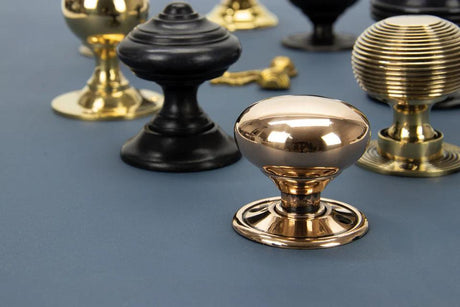
Centre door knobs come in traditional shapes such as beehive, bun, ball, octagonal and reeded patterns, and in sizes to suit the door, typically around 75mm across. Fit the knob centrally on the middle or lock rail at a comfortable height, and use bolt-through fixing so a heavy knob stays solid in daily use. Choose a hard-wearing outdoor finish - polished, aged or unlacquered brass, chrome, bronze or black - and match it to your letter plate, knocker and numbers for a co-ordinated period door. Browse our centre door knobs collection.
Door numbers and house numbers
Door numbers and house numbers make the property easy to find and finish the door properly. Individual numerals, letters and number plates come in finishes to match the rest of the ironmongery in our letters, numerals and signs collection.
Hinges and Thresholds for External Timber Doors
Hinges for external doors
External timber doors are heavy, so they need robust hinges. As a general rule, fit three 4 inch by 3 inch (100mm) ball bearing or washered hinges per door to carry the weight and take the daily use. Where a door must open back past a deep frame or reveal, parliament hinges throw the door clear. Choose from our door hinges collection.
Door thresholds
Choosing Materials and Finishes for External Use
The single biggest mistake with front door hardware is fitting an indoor-grade finish on an exposed outdoor door. Exterior door hardware has to cope with rain, sun, salt and temperature swings, so choose the material for the location:
- Grade 316 satin stainless is the safest choice for coastal and very exposed doors, as it resists salt corrosion far better than standard grade 304.
- PVD finishes (a hard-wearing coating on brass) hold their colour outdoors and resist tarnishing.
- Solid brass and bronze weather gracefully; unlacquered brass will patina to a living finish over time, which many people want on period doors.
- Avoid cheap electroplated finishes on fully exposed, seaside doors, as the plating can lift and pit.
If in doubt, tell us where the door is and we will point you to a suitable finish. You will find weather-ready options right across our door furniture range.
Why Buy Front Door Hardware from Trade Door Handles
We are more than just door handles. As part of a business that has supplied joiners and builders since 1976, we back our front door hardware with a knowledgeable, local team and a genuine same-day service. Order in by around midday on Carlisle Brass and Zoo Hardware lines and we can collect from both suppliers the same day, then pick, pack and hand to our local DPD hub for next-day UK delivery.
We supply a wide mix of customers, including:
- Architects, developers and building contractors
- General builders, joiners and carpenters
- Homeowners and self-builders
- Schools, hospitals, hotels and local councils

Front Door Hardware FAQs
What hardware do I need for an external timber front door?
At a minimum, a handle, knob or pull, a lock or rated nightlatch, and three external-rated hinges. Most doors then add a letter plate, and often a knocker, door viewer, escutcheon, door numbers and a threshold.
What is the best finish for front door hardware?
For exposed or coastal doors, grade 316 satin stainless or a good PVD finish resists the weather best. Solid brass and bronze also weather well, and unlacquered brass will patina naturally over time.
What size hinges do I need for a front door?
External timber doors generally use three 4 inch by 3 inch (100mm) ball bearing or washered hinges. Use parliament hinges where the door needs to open back past a deep frame or reveal.
Do I need an insurance-rated lock on my front door?
Many insurers require a BS3621 5 lever mortice lock or a TS007 3 star cylinder on final-exit timber doors. Check your policy wording, as requirements vary between providers.
What is a cylinder pull for?
A cylinder pull fits by the rim cylinder on a nightlatch door and gives you something solid to pull the door closed, so you are not gripping the edge of the door.
Can I get all my front door hardware in one finish?
Yes. Most ranges offer matching handles, letter plates, knockers, escutcheons and numbers in the same finish, so you can co-ordinate the whole door.
Summary
Front door hardware covers everything fitted to an external timber door: handles, plates, locks, hinges and accessories.
Lead with security - a BS3621 lock or rated nightlatch, plus quality hinges, is the priority on any front door.
For weather resistance, choose grade 316 stainless or a good PVD finish on exposed and coastal doors.
Fit three 4 inch by 3 inch ball bearing or washered hinges (parliament hinges for deep reveals) on heavier timber doors.
Finishing touches - letter plates, knockers, door numbers, viewers and escutcheons - let you co-ordinate the whole door.
Trade Door Handles supplies the full range with same-day dispatch on Carlisle Brass and Zoo Hardware and next-day UK delivery.