
Table of contents
Choosing Heritage Brass Mortice Knobs and Rim Knobs for Your Home
Supplied by Trade Door Handles, trusted UK supplier of architectural ironmongery since 1976, with quick nationwide delivery.
At Trade Door Handles we offer the full range of Heritage Brass architectural ironmongery products, and mortice knobs are one of the most requested items in our Kendal and Carlisle showrooms. Whether you are restoring a Victorian terrace, fitting out a 1930s semi or specifying door furniture for a new build, choosing the right door knobs makes a real difference to how every door looks, feels and works.
This guide explains how mortice knobs and rim knobs differ, which Heritage Brass designs suit which properties, and how to pick the right latch, size and finish. It is written by our ironmongery team, who have supplied joiners, builders, architects and homeowners for over 50 years.
What Are Mortice Knobs and Rim Knobs?
Both are turning door knobs supplied in pairs on a spindle, but they operate different types of lock. Knowing which lock you have is the first step to ordering the right product, and you can compare every brand in our mortice knobs and rim knobs collection.
How mortice knobs work

How rim knobs work
Mortice knobs vs rim knobs at a glance
- Lock position: mortice knobs work with a lock hidden inside the door; rim knobs work with a lock fixed to the door face.
- Typical doors: mortice knobs suit panelled and modern internal doors; rim knobs suit cottage, ledged and restoration doors.
- Interchangeability: rim knobs are made for rim locks only, so they cannot simply replace a mortice design.
- Look: matching designs mean you can mix both types in the same house with a consistent style.
Heritage Brass Mortice Knobs on Rose or on Backplate?
Mortice knobs on a round rose
A rose is the round base that fixes the knob to the door. Rose knobs give a clean, traditional look and are ideal for latch-only doors. Popular rose designs include Victoria, Richmond, Chester, Goodrich, Kensington, Westminster and the ornate Aydon. Concealed fixing designs such as Whitehall, Hampstead and Chelsea hide the screws for a smarter finish.
Mortice knobs on backplate
Backplate knobs put the knob and the keyhole or turn on a single plate, which gives a matched look and covers old fixing holes. Our Heritage Brass mortice knobs on backplate collection includes Beehive and Victoria on reeded plate, Victoria on a plain plate, the Art Deco Charlston and Broadway, and the low profile Balmoral. Each comes in four functions:
- Lever Lock - a standard keyhole for a mortice sashlock, for bedrooms and studies.
- Lever Latch - a plain plate for passage doors fitted with a tubular latch.
- Bathroom Set - a privacy turn inside and an emergency release outside.
- Euro Profile - a cut-out for a euro cylinder, useful for keyed-alike systems.


A note on Balmoral mortice knobs
Popular Heritage Brass Mortice Knob Styles
Beehive and reeded mortice knobs
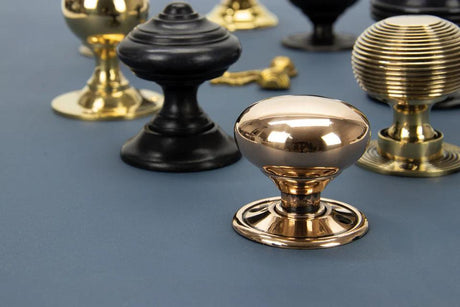
The beehive knob, with its stepped rings, is one of the most searched-for period designs in the UK. Heritage Brass offers it on a round rose, as a rim knob and on a reeded backplate. Compare every version in our beehive door knobs collection.

Oval mortice knobs

Porcelain mortice knobs

Knurled, concealed fixing and Art Deco designs
Choosing the Right Latch, Size and Finish
Sprung and unsprung mortice knobs
This is the detail most people miss. According to the M.Marcus 2025 catalogue:
- Sprung knobs (most Heritage Brass mortice knobs) need a lightly sprung or standard 76mm (3 inch) tubular latch.
- Unsprung knobs (Kensington, Westminster, Mayfair and all porcelain designs) need a 76mm heavy duty tubular latch. Both are available in our locks and latches range.
- Using the wrong latch can make a knob feel stiff or fail to return fully.
Measuring your door
Choosing a finish
Heritage Brass mortice knobs are made from solid brass and offered in a wide choice of finishes, including:
- Satin Brass, Polished Brass and Antique Brass for warm, traditional schemes.
- Satin Nickel, Polished Nickel, Satin Chrome and Polished Chrome for cooler, modern interiors.
- Matt Bronze and Matt Black for contemporary contrast.
To complete the look, pair your knobs with matching finger plates and push plates, escutcheons and hinges in the same finish.


Alternatives to Heritage Brass Mortice Knobs
Why Buy Heritage Brass Mortice Knobs from Trade Door Handles
Trade Door Handles is part of T.H. Wiggans Ironmongery Ltd, supplying architectural hardware since 1976. Our strapline is "More than just door handles" - we supply over 30,000 products and supply architects, builders, joiners, developers, hotels, schools, hospitals and councils as well as homeowners. When you order from us, you are dealing with a local, experienced team who can check latches, spindles and finish matches before you order.
More than just door handles
Frequently Asked Questions About Mortice Knobs
What is the difference between mortice knobs and rim knobs?
Mortice knobs operate a latch or lock fitted inside the edge of the door. Rim knobs operate a rim lock that is screwed to the face of the door. Rim knobs are made for rim locks only.
What latch do I need for mortice knobs?
Sprung mortice knobs need a lightly sprung or standard 76mm (3 inch) tubular latch. Unsprung designs, including porcelain knobs, need a 76mm heavy duty tubular latch.
Can I get mortice knobs with a keyhole?
Yes. Knobs on backplate are available with a lever lock keyhole, a euro cylinder cut-out or a bathroom turn and release, as well as a plain latch plate.
What finishes are Heritage Brass mortice knobs available in?
Finishes include Satin Brass, Polished Brass, Antique Brass, Satin Nickel, Polished Nickel, Satin Chrome, Polished Chrome, Matt Bronze and, on selected designs, Matt Black.
Are oval or round mortice knobs easier to use?
Oval knobs are generally easier to grip and turn because the shape gives the hand more leverage than a round knob.
What door thickness do Balmoral mortice knobs need?
Balmoral knobs on plate need a door at least 44mm thick and a 38mm bore to accept the spring mechanism.
Summary
Mortice knobs work with a lock inside the door; rim knobs work with a surface-mounted rim lock.
Heritage Brass mortice knobs come on a round rose or on a backplate with lock, latch, bathroom and euro functions.
Popular styles include beehive, reeded, oval, porcelain, knurled and Art Deco.
Match sprung knobs to a standard 76mm latch and unsprung knobs to a heavy duty latch.
All designs are made from solid brass in a wide range of finishes.
Trade Door Handles has supplied architectural ironmongery since 1976, with expert advice and nationwide delivery.