
Table of contents
Kitchen and Cabinet Hardware: A Complete Guide
Supplied by Trade Door Handles, trusted UK supplier of architectural ironmongery since 1976, with quick nationwide delivery.
At Trade Door Handles we supply a large range of architectural ironmongery and cabinet hardware for the home and commercial settings. As part of T.H. Wiggans Ironmongery Ltd, we have supplied the trade and the public since 1976, with trade counters in Kendal and Carlisle and quick nationwide delivery. We stock and supply cabinet hardware from many of the UK's leading names, including Carlisle Brass, Zoo Hardware, Heritage Brass, Atlantic and From The Anvil, alongside British makers such as Samuel Heath, Frank Allart, Croft Hardware and Kirkpatrick. This guide explains the main types of kitchen and cabinet hardware, the finishes and materials they are made from, and where you can use them, so you can choose the right fittings for your project with confidence.
Cabinet hardware is the collective name for the small but important fittings that let you open and close cupboard doors and drawers. It covers cabinet knobs, pull handles, cup pulls, flush pulls, edge pulls, catches and drop pulls. Although it is often called kitchen hardware, the very same fittings suit bathroom cabinets, dressers, wardrobes, sideboards and furniture of every kind. Good cabinet hardware is both practical and decorative: it stands up to daily wear, yet it also sets the tone of a room.
What is cabinet hardware?
Cabinet hardware is any knob, handle, pull or catch fitted to a cabinet, cupboard or drawer front. These fittings do two jobs at once. They are functional, giving you a comfortable grip to open a door or drawer, and they are decorative, acting as the jewellery of a kitchen or a piece of furniture. Because they are touched every single day, quality matters - well made cabinet hardware feels solid in the hand, resists tarnishing and holds its finish for years rather than months.
The right cabinet hardware can transform a plain unit into a designer piece. Swapping tired handles for a fresh style is one of the quickest and most affordable ways to update a kitchen, and it is a job most people can complete with a screwdriver.
What is cabinet hardware made from?
Most cabinet hardware is made from solid metal for strength and a quality feel, then plated or lacquered in a chosen finish. Common materials and finishes include:
- Solid brass - a premium, hard-wearing base often used for satin brass, antique brass and polished brass finishes.
- Stainless steel and zinc alloy - durable, cost-effective options widely used for modern bar handles and knobs.
- Iron and pewter - favoured for traditional, rustic and period styles, especially from blacksmith-inspired ranges.
- Ceramic, porcelain and glass - decorative inserts used on knobs for country, shaker and vintage kitchens.
Popular finishes across the range include satin brass, polished chrome, satin nickel, matt black, antique brass and pewter. Choosing one finish and carrying it across your knobs, handles and catches gives a co-ordinated, considered look.
Types of cabinet hardware explained
There are several distinct types of cabinet hardware, and each has its own strengths. Below we explain each one and link to the matching collection. We will publish a dedicated in-depth guide on every type, so treat this as your starting point.
Cabinet knobs
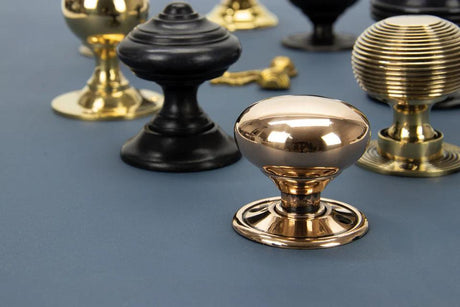
A knob is the simplest form of cabinet hardware: a single fixing point gripped between finger and thumb. Knobs suit doors and smaller drawers, and they are a classic choice for shaker, country and traditional kitchens. They come in countless shapes - round, mushroom, faceted, hexagonal and octagonal - and in materials from solid brass to ceramic and glass. Brass cabinet knobs remain a firm favourite for warm, timeless schemes. Browse the full range of Kitchen and Cabinet Knobs to find a style to match your units.

Cabinet pull handles and bar handles
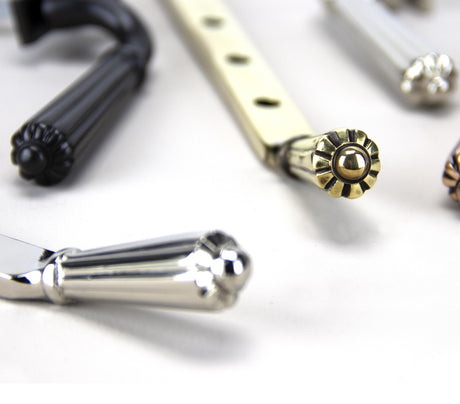
Pull handles, often called bar handles or T-bar handles, are fixed at two points and offer a longer, fuller grip than a knob. They are the go-to choice for drawers and larger doors, and they suit modern, industrial and handleless-style kitchens especially well. Pull handles are measured by their overall length and, more importantly, by their hole centres - the distance between the two fixing holes - so it is easy to match a replacement to existing holes. Explore the Kitchen and Cabinet Pull Handles collection for bar handles in every popular length and finish.

Cup pulls and cup handles
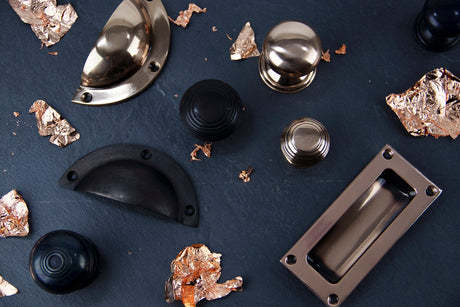
A cup pull, also known as a cup handle, is a half-moon fitting that you hook your fingers underneath to pull. It is a signature detail of shaker, Georgian and farmhouse kitchens, and it works beautifully on drawers. Cup pulls are usually paired with matching knobs on the doors for a co-ordinated period look. See the Kitchen and Cabinet Cup Pulls collection for cup handles in satin brass, antique brass, chrome and black.

Flush pulls
Flush pulls, sometimes called recessed cabinet handles, sit level with the surface so nothing protrudes. They are ideal for sliding doors, pocket doors, wardrobes and any situation where a raised handle would get in the way or spoil a clean, minimalist line. Because they are recessed, they are also a smart safety choice in busy commercial spaces. View the Kitchen and Cabinet Flush Pulls collection for round, rectangular and finger-pull styles.

Edge pulls
Edge pull handles fit to the top or side edge of a door or drawer, giving a discreet grip without a visible handle on the face. They are a key part of the handleless kitchen look that has become so popular, delivering a sleek, uninterrupted run of units. Discover the Kitchen and Cabinet Edge Pulls collection for slimline edge profiles in a choice of lengths and finishes.

Cabinet catches
Not all cabinet hardware is about lifting and pulling - catches keep doors closed. A magnetic cabinet catch uses a magnet to hold a door shut, a roller catch grips a striker between sprung rollers, and a ball catch holds with a spring-loaded ball. Catches are the quiet workhorses of any cabinet, and choosing the right strength stops doors drifting open. Browse the Kitchen and Cabinet Catches collection for magnetic, roller and ball catches to suit light and heavier doors.
Drop pulls and drop handles
Drop handles, also called drop pulls, hang down from a backplate and swing when lifted. They bring instant vintage and antique character and are a favourite for dressers, sideboards and reproduction furniture. Paired with the right finish, they give a piece real period authenticity. See the Kitchen and Cabinet Drop Pulls collection for swing and drop styles in antique and aged finishes.
Where can you use cabinet hardware?
It is a common myth that this is only kitchen hardware. In practice, the same fittings work almost anywhere you have a door or a drawer. You can fit them to:
- Bathroom cabinets and vanity units
- Bedroom furniture, dressers and chests of drawers
- Fitted and freestanding wardrobes
- Sideboards, dressers and display cabinets
- Home office and utility room units
- Bespoke joinery and commercial fit-outs
Choosing a single family of fittings and carrying it through a whole room - or a whole home - is an easy way to create a joined-up, professional finish.
Do you have to buy cabinet hardware from your kitchen supplier?
No, and this is one of the best-kept secrets in kitchen design. When you order a new kitchen, you are never obliged to take the standard handles offered by the kitchen supplier. Fitting your own choice of handles is one of the simplest ways to make a mass-produced kitchen feel unique and bespoke. The benefits are clear:
- More choice - access hundreds of styles and finishes rather than a handful of standard options.
- Better value - buying your hardware separately often costs far less than the supplier's upgrade price.
- A unique look - the right handles lift an off-the-shelf kitchen into something that feels designed for you.
- Easy to change later - handles are simple to swap, so you can refresh the look in future without a new kitchen.
How to choose and place cabinet hardware
Two questions come up more than any other: knobs or handles, and where to put them. As a rule of thumb, knobs suit doors and small drawers, while pull handles suit wide drawers and taller doors - though many kitchens happily mix the two, using knobs on wall units and bar handles on base drawers. For placement, a few tried-and-tested guidelines help:
- On a door, fit the knob or handle on the opening edge, opposite the hinges.
- On upper (wall) cabinets, place hardware in the lower corner of the door for easy reach.
- On lower (base) cabinets, place hardware in the upper corner of the door.
- On drawers, centre a knob, or centre a pull handle horizontally for balance.
- Match your hole centres to any existing holes when replacing bar handles to avoid re-drilling.
If in doubt, mock up a couple of positions with low-tack tape before you drill - it takes seconds and saves mistakes.
Frequently asked questions about cabinet hardware
Where should you place handles on kitchen cabinets?
Fit hardware on the edge of the door opposite the hinges. On wall cabinets, place the knob or handle in the lower corner for easy reach; on base cabinets, place it in the upper corner. On drawers, centre a knob, or centre a pull handle horizontally.
What size handles do kitchen cabinets need?
There is no single size, but knobs of around 25 to 40mm suit most doors, while pull handles are chosen by hole centres - commonly 96mm, 128mm or 160mm on drawers, with longer bars on wide pan drawers. When replacing bar handles, match the existing hole centres.
What is cabinet hardware made from?
Most cabinet hardware is solid metal - typically brass, stainless steel or zinc alloy - then plated or lacquered in finishes such as satin brass, chrome, matt black or antique brass. Knobs may also feature ceramic, porcelain or glass.
Can you use kitchen cabinet hardware on other furniture?
Yes. The same knobs, pulls and catches suit bathroom cabinets, wardrobes, dressers, sideboards and all kinds of furniture. Only the fixing length may need to suit thicker doors or drawer fronts.
Do you have to buy cabinet hardware from your kitchen supplier?
No. You are free to buy your own handles and knobs, which usually gives you far more choice and better value, and lets you personalise an off-the-shelf kitchen.
Are knobs or handles better for kitchen cabinets?
Both work well. Knobs suit doors and small drawers and give a traditional look; pull handles give a fuller grip and suit wide drawers and modern kitchens. Many kitchens mix the two.
Summary
Cabinet hardware is the collective name for knobs, pull handles, cup pulls, flush pulls, edge pulls, catches and drop pulls.
It is both functional and decorative, and swapping it is one of the quickest ways to update a kitchen or furniture.
The main types are cabinet knobs, pull handles and bar handles, cup pulls, flush pulls, edge pulls, catches and drop handles.
Most cabinet hardware is solid brass, stainless steel or zinc alloy, finished in satin brass, chrome, matt black, antique brass and more.
The same fittings suit bathroom cabinets, wardrobes, dressers, sideboards and all furniture, not just kitchens.
You do not have to buy your handles from the kitchen supplier - choosing your own makes a kitchen unique and often costs less.
Match hole centres when replacing bar handles, and place hardware on the opening edge of doors.